Observatory

Our telescope

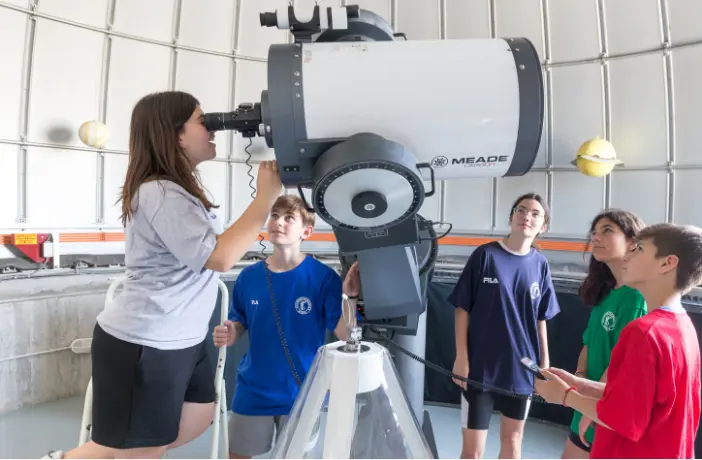
The Ellinogermaniki Agogi Observatory began operating in January 2007. It houses a 40 cm diameter MEADE LX200R robotic telescope, which features an advanced Ritchey Chrétien optical system comparable to those used in modern observatories. Its focal length is 4.064 meters (f/10). It includes a catalog of 145,000 celestial objects, while a 16-channel GPS receiver is used for its precise orientation. The telescope is housed in an imposing dome with a diameter of 6.3 meters and a height of 12 meters.

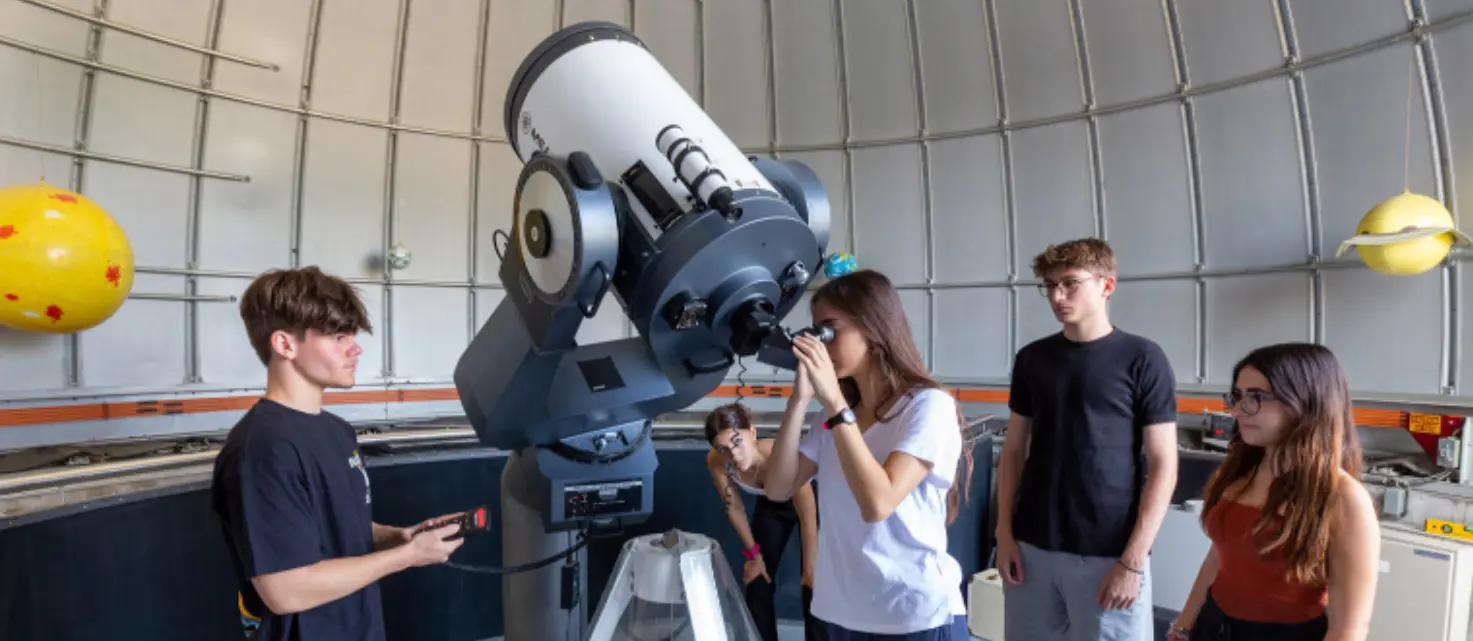
The Hellenic-Germanic Education Observatory began operating in January 2007.

Astronomy and Education

By installing and operating a telescope on the school premises, we aspire to give students and teachers the opportunity to observe and investigate the phenomena that develop in the sky, which constitutes a unique and inexhaustible scientific laboratory, now accessible to everyone. Through a series of educational applications and scenarios, students and teachers can experience the basic principles of observational astronomy and scientific research. The telescope can also be used remotely at night through an online platform that allows requests for observations to be sent. With this telescope, our school participates in the international network of robotic telescopes DISCOVERY SPACE (www.discoveryspace.net), which is used by students and teachers all over the world.

Suggestions for observing celestial objects

This website is not an astronomy manual. Its aim is to present an indicative list of the most impressive celestial objects that are observable with a telescope, providing useful information to those who wish to better understand the night sky and what is happening in it.

It is 380,000 kilometers from Earth. Its observation is most interesting when it is done several days before or after the full moon, when it is in the 1st or 3rd quarter (crescent) phase. At that time, the shadows on the craters and mountains of the Moon are larger and give an impressive three-dimensional sense of depth.

It is possible to observe all the planets of our solar system. The following are specifically mentioned:

Its diameter is about 9/10 of the diameter of the Earth. During its orbit around the Sun, you can see its phases ("waxing", "filling"), like those of the Moon. Venus appears white, as the Sun's light rays are reflected by the clouds that cover its entire surface.

Its diameter is about half that of Earth. It looks like a red-orange disk with dark and bright areas. At the poles of Mars we can see areas of ice, like those of Earth in the Arctic and Antarctica. Every two years, when Mars is closer to Earth, we can see more details on its surface.

It is the largest planet in our solar system. Its diameter is 11 times that of Earth. It appears as a disk with dark and bright stripes along its surface. These stripes are clouds in its atmosphere. Four of its satellites (Io, Europa, Ganymede, Callisto) are visible as bright spots. These bright satellites of Jupiter were first observed by Galileo in 1610.

Its diameter is 9 times larger than the diameter of the Earth. Observing Saturn with a telescope is a beautiful sight. The characteristic rings that surround the planet give the impression of a three-dimensional spherical object. With the telescope, a zone separating the rings is visible, which is called the Cassini division. Five of Saturn's satellites, Rhea, Dione, Tethys, Enceladus and, the largest of all, Titan, are visible near the planet.

All the stars we see with the naked eye are essentially objects like our Sun, self-luminous. Due to their enormous distance from our solar system, all stars appear as bright points, regardless of the size of the telescope.

These are huge interstellar clouds of gas and dust found in our galaxy and in every spiral galaxy, which are potential star formation regions. Their condensation due to gravity creates stars. One of the most impressive is the Orion Nebula (M42), which is 1,600 light years from Earth.

These are stars in the penultimate stage of their lives, before their final demise as white dwarfs. The outer shell of gaseous atmosphere that had been expelled by the stars in an earlier phase of their lives is ionized by the white dwarfs in the core and they radiate. The name was given because, when we observe these nebulae with a telescope, they usually have a disk shape, like planets. Only a thousand planetary nebulae have been discovered so far, as their lifespan is relatively short. Within 50,000 years, these gases disperse into space. The planetary nebula M57 in the constellation Lyra is a typical example.

Open Star Clusters consist of many young stars, recently formed from the same interstellar nebula. One of them is our well-known "Pleiades" (M45), which is 410 light-years from Earth.

Globular Star Clusters consist of several thousand to several hundred thousand stars that are gravitationally bound. Their spatial arrangement is spherical and their distribution is dense at the core of the cluster and gradually more sparse at the periphery. They are a beautiful sight in the telescope. The best known are the Great Globular Cluster of Hercules (M13) with 500,000 stars, and Omega Centauri, with about 1,000,000 stars.

Galaxies are large collections of hundreds of billions of stars, bound together and orbiting a common center of mass due to gravity. The two main types of galaxies are spiral galaxies, like our own, which also contain many nebulae and star clusters, and elliptical galaxies, which are either dwarf or giant in size. The Andromeda Galaxy (M31) is the nearest large spiral galaxy and is 2.2 million light-years from Earth.

Astronomy Nights

Contact the Observatory

Ellinogermaniki Agogi
Dim. Panagea, 15351 Pallini

T: 210 8176700
E: asteroskopeio@ea.gr