

Language
In Hellenic-German Education, Language is not simply taught, it is cultivated. From the first day of school in 1st grade to 3rd grade of high school, students approach language as a means of thinking, expression and identity.


In Hellenic-German Education, Language is not simply taught, it is cultivated. From the first day of school in 1st grade to 3rd grade of high school, students approach language as a means of thinking, expression and identity.

Language learning begins through experiential and creative contact with spoken and written language. Children approach spoken and written language through activities that enhance their imagination and initiative. They learn to express themselves clearly, to argue and to enjoy the process of communication. Contact with literature in the school library cultivates their critical thinking and love of reading.
Language teaching takes on greater depth and meaning. Students learn to organize their thinking, choose the appropriate style, adapt their expression to different communication situations, and understand the power of words as a means of thought. Through systematic engagement with literature, creative writing, and ancient Greek, they discover the continuity of the Greek language.


Language teaching becomes more reflective and demanding, preparing students for their academic career and public speaking. They develop the ability to compose scientific and research texts, develop a well-founded opinion and shape a personal style of expression. Through the study of literary and philosophical works, as well as participation in creative and rhetorical activities, they learn to express their ideas with maturity and confidence, to express themselves correctly in writing and to recognize language as a living means of understanding the world.
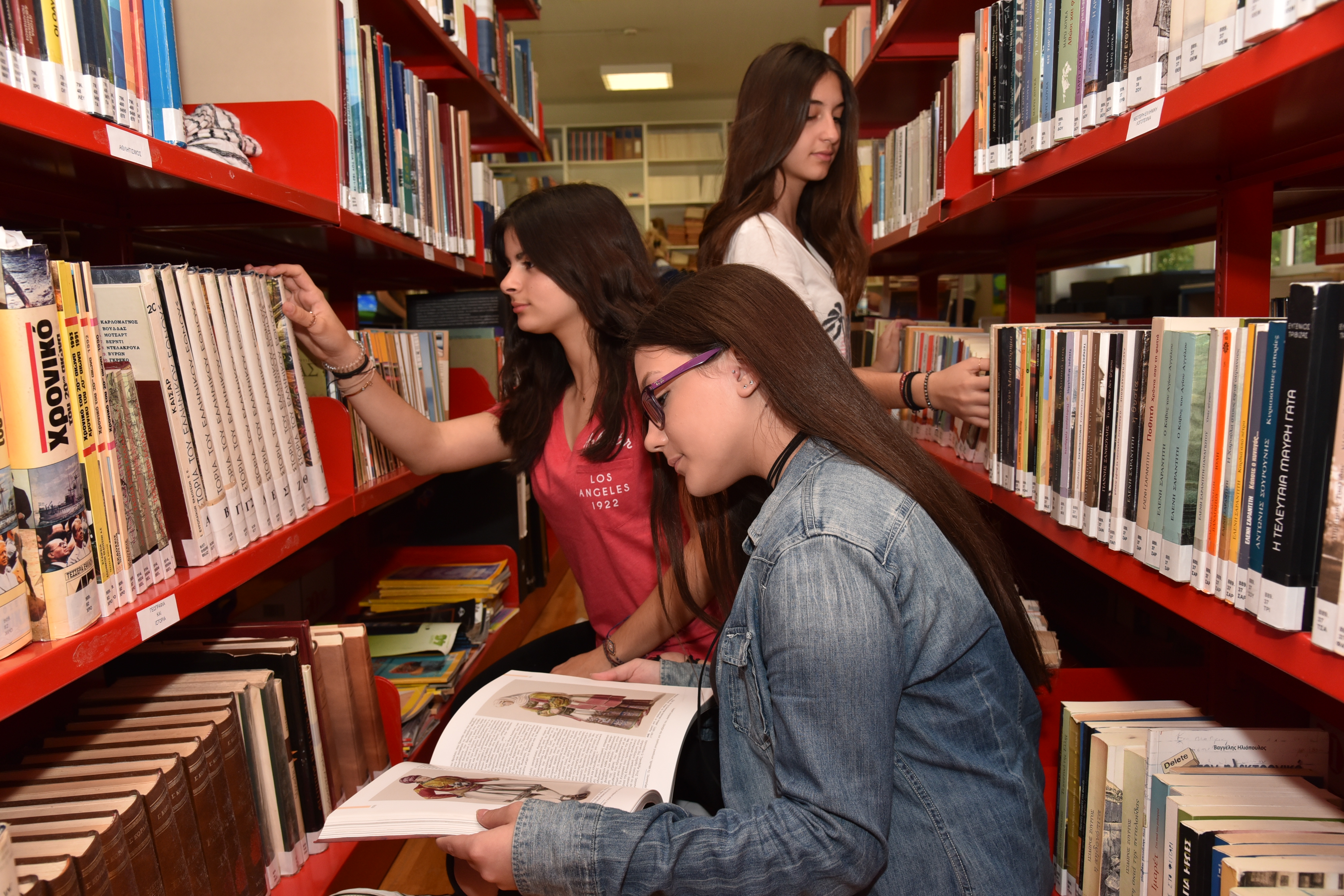
At every level, the Library is a key axis of the learning process and a reference point for the cultivation of linguistic and aesthetic education. Scheduled visits, meetings with authors and various educational activities encourage a love of reading, strengthen children's critical thinking and cultivate students' deeper relationship with books.
History
History, from the first grades of elementary school to high school, is not limited to a simple narration of events, but is transformed into a living lesson that enhances creativity, cultivates thinking, connects the past with the present and helps students better understand the world around them.

Students' first contact with the history lesson is experiential, through the distinction between myth and historical reality. From the very first grades, children learn to distinguish between reality and fiction and to understand that historical truth is based on archaeological findings and evidence. Through narratives, audiovisual material, interactive games, constructions and activities using technology, they approach the past in a lively and creative way. The interdisciplinary approach enhances experiential learning and helps children understand the continuity of human civilization. They gradually develop the ability to recognize the importance of events, understand the temporal sequence and respect the achievements of each era.
In Middle School, History teaching fosters inquiry and critical thinking. Students learn to formulate genuine questions, to seek causes and effects, to identify relationships between events, and to understand continuity and change over time. They become familiar with the correct use of historical terms and sources, learning to evaluate the credibility and perspective of each testimony. Teaching encourages dialogue and collaboration, helping students connect historical events with contemporary social issues and to perceive History as a living field of understanding the world.

The approach to History in High School acquires depth and methodological consistency. Students practice analyzing primary and secondary sources, comparing different points of view and interpretations, and reconstructing the historical narrative, utilizing a variety of tools, such as maps, diagrams, and tables. They are encouraged to form a personal opinion, recognize the subjectivity of historical narrative, and approach events with a spirit of research and documentation. Thematic teaching focuses on the events that shaped the physiognomy of modern Greece, cultivating in students the ability to understand, analyze, and synthesize.
The teaching of Social Sciences aims to cultivate knowledge, attitudes and values that lead to active, responsible and aware citizens. Through the gradual introduction to the social structures, institutions and phenomena that shape our world, students develop the ability to understand, analyze and contribute creatively to society.
In Elementary School, students approach the world around them through experiential activities, role-playing and collaborative work. They learn to recognize the importance of community, cooperation and respect for the rules and rights of all. Through activities that connect the school with the local community, they cultivate the first skills of active citizenship, develop empathy and environmental awareness and understand the power of collective effort.


In middle school, students study and understand how institutions, states and societies function, recognize the values of democracy and human rights and understand the importance of responsible civic participation. Through discussions, they develop critical thinking and learn to connect theory with practice. Global skills, such as intercultural understanding and social sensitivity, strengthen their ability to operate with an open mind in an ever-changing world.
In High School, students approach Social Sciences with greater maturity and reflection. The study of Political Economy, Sociology and the institutions of democracy helps them to analyze social and economic phenomena in a well-documented manner and to understand the position of the individual within global interdependencies. They are encouraged to express well-documented opinions, to participate in social service activities and to undertake initiatives of social interest.